
Budget Tracking for Nonprofits
Budget tracking is the process of monitoring your nonprofit’s income and expenses to ensure they stay within your planned budget. Effective budget tracking is essential to financial transparency, efficient resource allocation, and strategic planning for your nonprofit.
Tracking your budget helps with overall budget management, which contributes to your financial stability and the success of your nonprofit mission.
Keep reading to learn more about budget tracking and how it can help your organization improve financial efficiency and effectiveness.
Budgets are Essential for Nonprofit Organizations
While they can be overwhelming to create, having a budget is a necessity for any organization. Think of your nonprofit budget as the financial roadmap for your organization. With a budget in place, you can easily align your finances with the mission of your organization to achieve goals.
Not only will you need a budget for operations and internal decision making, you will also need a budget for grant applications and when asking for gifts from the general public.
As you get started with the budget making process, here are a few things to keep in mind:
- Include a detailed look at all revenue sources. Start with the certain revenue streams and work your way to the less certain (we’ll cover this in more depth later).
- Include programs, fundraising, and administrative costs
- Budget by program (if applicable)
- Budget for a surplus to finance expansion in future years
Without a budget in place, you’re left scrambling to ensure you have the funds to cover expenses, such as paying employees or funding nonprofit programs.
But your budget shouldn’t be a “set it and forget it” plan. You also need to track your expenses and income to make sure you’re sticking to your carefully-planned budget. The role of budget tracking is to ensure resources are allocated correctly, especially to key initiatives that are essential for organizational success.
A budget and tracking system also help with transparency and accountability at all levels of your organization. It’s easy to audit a nonprofit budget to check for potential errors and reduce the possibility of fraud.
Creating a Comprehensive Nonprofit Budget – Start with the Details
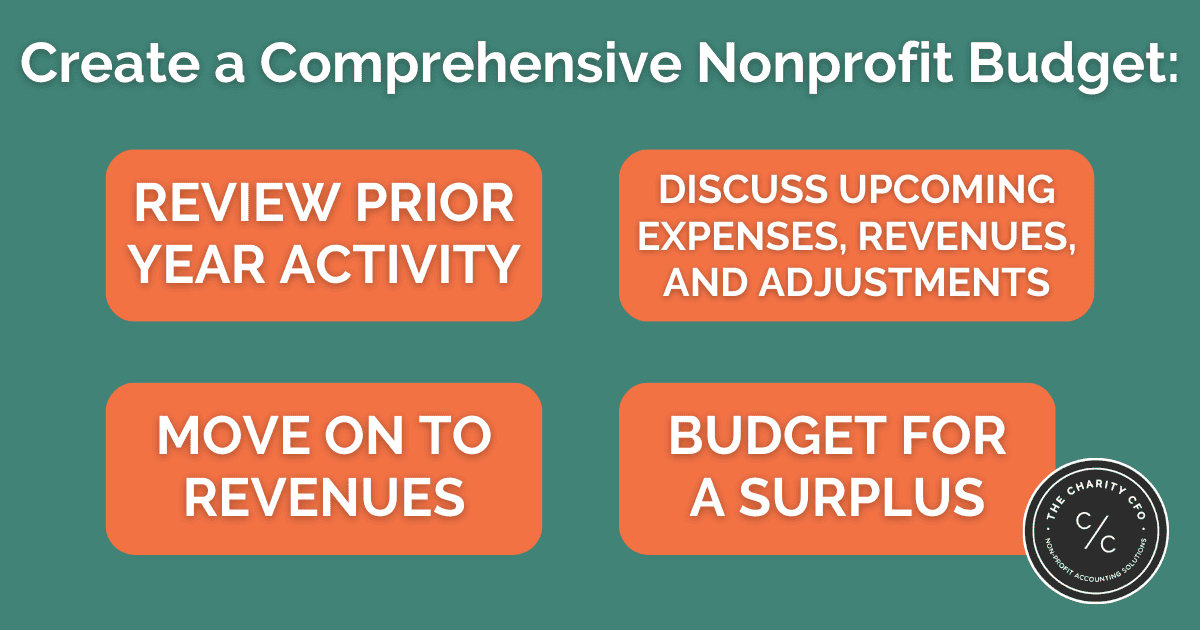
There are two common ways to budget; starting high-level and moving granularly or starting granularly and moving high-level. At The Charity CFO, we like to do the latter because we feel it leaves you with a more realistic budget base. From there, we move on to reviewing the prior year’s activity.
Review Prior Year Activity
To review your prior year’s activity, you’ll use a “Profit and Loss Detail” report or something similar. This is found in your accounting system and you’ll want to run a report based on the current year. It’s the best way to review current-year expenditures for what you might be spending next year, in fact, you can consider it as a template for your budget.
Discuss Upcoming Expenses, Revenues, and Adjustments
Go line by line with the Profit and Loss Detail. Start with expenses and figure out what investments you need to be making in the coming year to achieve your goals and objectives. Try not to think about where the money is coming from, just think of the ideal scenario about who you want to hire, the investments you want to make, and the cost of the space you’re using.
Start with the largest expense and map it out in detail. (Example: The largest expense is typically payroll. Consider exactly what you want to pay each employee.) Then move to the next largest. Continue this process until you’ve reviewed every expense. We advise you to be a little generous in these categories. It’s better to expect more expenses than to underestimate.
Move On To Revenues
Start by recording what you expect to fundraise in the coming year. We like to start with any revenue that is most certain and then work our way to the least certain. For example, if you receive an annual grant from the government, that’s a fairly “certain” revenue. Budget these first.
Then move on to your less certain revenue streams, like fundraising event income, because these are tougher to estimate. Our tip: budget conservatively for these.
Budget for a Surplus
Once you’ve gone through all of your revenue and expenses, you’ll need to see if you are in a surplus or a deficit for the coming year. Your goal is to be in a surplus so that you can financially expand in the future.
Keep in mind that you won’t be able to budget in a massive surplus; your funders won’t let you get away with that. However, a modest surplus will allow you to build up your reserves so that you can fund your next growth plan. This will look different for every organization.
For a more detailed explanation of creating a budget, check out this video.
Leverage Budget Tracking for a More Successful Nonprofit
Your nonprofit’s budget only works if you know you’re sticking to it. Implementing a budget tracking system helps you monitor your budget so you can stay on target to meet financial goals.
Make creating an effective budget tracking strategy a priority as you set your upcoming budgets. Taking the time to set up your tracking correctly will aid in the long-term financial success of your organization.
Not sure where to start with creating your budget tracking system? Working with a nonprofit accountant like The Charity CFO takes the challenge off of your plate. As financial professionals specializing in nonprofit financial success, our team can help you create and implement an effective budget tracking strategy no matter the size or revenue of your organization.
Contact us today to get started building your budget tracking system.