
• NEWSLETTER
    • Schedule a Call
    The Charity CFO
    • Services
      • Bookkeeping
      • Accounting
      • Grant Management
      • Budgeting & Forecasting
      • Audit Assistance
      • System Migration & Tech Integration
      • Tax Preparation
    • Who We Serve
      • Human & Social Services
      • Education & Workforce Development
      • Youth & Community Development
      • Health & Human Services
      • Legal, Advocacy & Civil Rights
      • Religious & Faith-Based
      • Arts, Cultural & Environmental
      • Fundraising & Philanthropy
      • Animal Rights and Welfare
    • About
      • Our Team
      • Our Process
    • Resources
      • Blog
      • Podcast
      • Testimonials
      • Newsletter
    • Careers
    • Menu Menu
    tax

    Discovering The Tax Implications of Nonprofits Owning For-Profit Businesses

    December 27, 2023/in CharityCFO, Nonprofit, Taxes/by Paul Cook

    No time to read this article now? Download it for later.

    Does your nonprofit have ownership of a for-profit entity? Whether your organization owns a for-profit company outright or has limited ownership, a for-profit subsidiary can have serious tax implications for your nonprofit.

    Let’s work through some of the most pressing tax implications you might face as a nonprofit with ownership in a for-profit company.
    tax

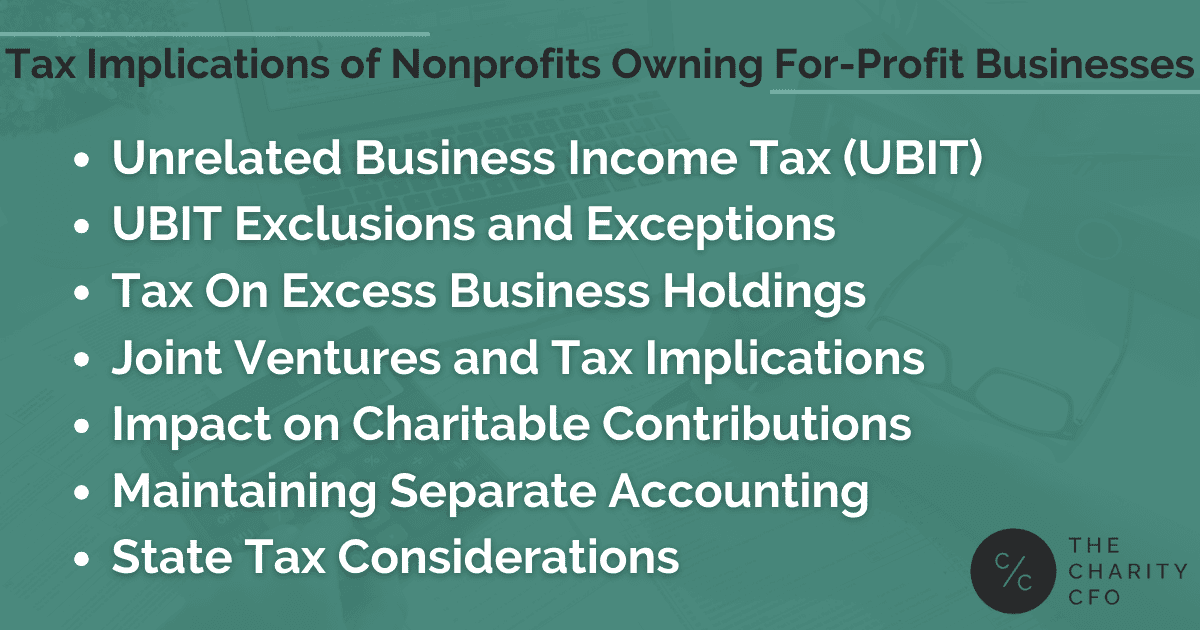
    Tax Implications of Nonprofits Owning For-Profit Businesses

    Unrelated Business Income Tax (UBIT)

    Recognized nonprofits generally receive tax-exempt status from the federal government. Tax-exempt status makes it easier for your organization to retain nonprofit revenue and meet the goals of your mission.

    However, your nonprofit may engage in revenue-generating activities that don’t relate to the purpose of your organization. The money that comes from these activities is known as unrelated business income because it’s earned from activities that are unrelated to your exempt mission.

    The IRS can potentially charge your organization federal income taxes on your unrelated earnings. Known as unrelated business income tax (UBIT), you may face this tax liability if your nonprofit regularly carries on a trade or business that doesn’t substantially relate to your exempt mission or purpose.

    UBIT Exclusions and Exceptions

    Not all unrelated business income is subject to federal income tax. The IRS provides UBIT exceptions and exclusions to account for situations where a nonprofit uses for-profit activities to advance its exempt purpose.

    Common nonprofit income that could be excluded from UBIT includes:

    • Dividends and Other Investment Income
    • Interest Earnings
    • Royalties
    • Certain Rental Income
    • Gains or Losses from the Disposition of Property

    Additionally, income generated using a majority volunteer labor force may qualify for an exception. For example, hosting a fundraising auction operated by volunteers may not require UBIT payment.

    Tax On Excess Business Holdings

    The IRS uses taxes on excess business holdings to limit how much ownership a nonprofit can have in a for-profit company without paying federal taxes. Taxing excess business holdings helps reduce conflicts of interest and limits the power a tax-exempt entity has over a business.

    Excess business holdings are shares or interests a nonprofit holds in a for-profit company that exceeds the IRS’s limits. Generally, any ownership share over 20% of voting stock in a company is considered an excess business holding. Nonprofits with excess holdings may face an excise tax on the value of shares over the limit.

    Joint Ventures and Tax Implications

    Many nonprofits partner with for-profit entities to help advance their mission with the financial backing of their partner. For example, a mental health organization might create a joint venture with a for-profit healthcare system to establish mental health facilities in underserved areas.

    Depending on the nature of the joint venture, nonprofits could jeopardize their tax-exempt status if they don’t follow certain limitations, including:

    • The joint venture must seek to further the nonprofit’s charitable purpose.
    • Any benefits to the for-profit entity must be insubstantial compared to the public benefit of the partnership.
    • The nonprofit must have control over the charitable activities of the venture.

    You may want to work with a nonprofit financial advisor or accountant to set up a joint venture with a for-profit entity. Your advisor can help you avoid pitfalls that could affect your tax-exempt status.

    Impact on Charitable Contributions

    Donors to nonprofits often receive tax benefits for their charitable giving. In most cases, a donor may be able to deduct certain charitable donations from their taxes. Many donors use nonprofit donations to lower their taxable income for the year.

    Giving money to a nonprofit with for-profit business ownership could limit the donor’s ability to deduct donations, however. If your nonprofit engages in for-profit activities, you’ll need to communicate with donors to let them know. Proper communication helps donors understand the tax implications of their gifts and improves your organization’s transparency.

    Maintaining Separate Accounting

    Any nonprofit with for-profit ownership needs to maintain separate accounting for each area of business. This includes keeping separate financial statements, revenue records, and bank accounts.

    Separating business activity is essential for maintaining accurate records of income, expenses, and activities associated with each business. Properly-recorded books can help reduce your chance of noncompliance in a nonprofit audit.

    State Tax Considerations

    The tax implications we’ve already covered mostly relate to federal tax-exempt status.

    However, state tax agencies may also have rules for nonprofits that operate for-profit businesses. You’ll need to check your state’s tax laws and regulations to see how they might affect your organization.

    Seek Professional Guidance for More on the Tax Implications of Nonprofits Owning For-Profit Businesses

    tax

    Few parts of nonprofit accounting are as complicated as a nonprofit owning a for-profit business. Your organization may be liable for certain taxes on excess business holdings or income from unrelated business activities. In some cases, operating a for-profit entity could put your nonprofit at risk of losing its tax-exempt status.

    Nonprofit leaders like you don’t have to navigate tricky tax implications on your own. Working with a trusted nonprofit tax advisor, like The Charity CFO, gives you the resources to avoid unwanted tax implications.

    Our team of dedicated nonprofit accountants and financial advisors is ready to put our specialized knowledge to work for your organization. Reach out to us today to get started!

    Tags: nonprofits, tax, taxes
    Share this entry
    • Share on Facebook
    • Share on X
    • Share on WhatsApp
    • Share on Pinterest
    • Share on LinkedIn
    • Share on Tumblr
    • Share on Vk
    • Share on Reddit
    • Share by Mail
    You might also like
    The Insider’s Guide to Bookkeeping Services For Nonprofit Organizations
    How to Manage Payroll as a Nonprofit
    This episode covers nonprofit taxes. Nonprofit Taxes & the IRS: Ep. 2 of A Modern Nonprofit Podcast
    Preparing for a Not-for-Profit Audit: Episode 3 of A Modern Nonprofit Podcast
    Modern Fundraising: Community Centric Fundraising Movement
    Provide a ‘WOW’ Experience in your Nonprofit Marketing
    revenue How to Properly Record Revenue for Nonprofits
    nonprofit Employee Benefits to Offer as a Small Nonprofit
    Popular
    • What is Financial Oversight?
      Nonprofit Accounting Tips, Tools, & Tricks Your Organization...January 22, 2020 - 4:23 pm
    • nonprofit fundraising strategies
      Do Nonprofits Pay Taxes? This is What You Should KnowJanuary 22, 2020 - 4:31 pm
    • The Charity: 6 Common Tax Mistakes that Non-Profits Mak...January 22, 2020 - 4:55 pm
    • We’re Hiring!January 29, 2020 - 9:31 pm

    Categories

    • Accounting
    • Accounting, Budgeting & Leadership Strategy
    • Accounting|Audit|CharityCFO
    • Accounting|Audit|Grants|Nonprofit|Reporting|Taxes
    • Accounting|Audits|Expenses|Fundraising|Grants|Nonprofit|Operations|Reporting
    • Accounting|Board Management|Leadership|Nonprofit|Operations
    • Accounting|CharityCFO
    • Accounting|Expenses|Grants|Nonprofit|Reporting
    • Accounting|Fundraising|Grants
    • Accounting|Leadership|Nonprofit
    • Audit
    • Audits
    • Board Management
    • CFO Responsibilities
    • CFO Services Transition
    • CharityCFO
    • CharityCFO|Nonprofit
    • Compliance and Taxation
    • COVID-19 Response
    • Cryptocurrency
    • Diversified Funding Models
    • Expenses
    • Fractional & Outsourced Executive Services
    • Fundraising
    • Grants
    • Investment
    • Leadership
    • Leadership|Nonprofit|Operations
    • Miscellaneous
    • Nonprofit
    • Nonprofit Financial Leadership
    • Nonprofit Financial Maturity
    • Nonprofit Financial Operations
    • Nonprofit Revenue Strategies
    • Nonprofit Revenue Strategy
    • Nonprofit Strategic Leadership
    • Operations
    • Payroll
    • Reporting
    • Taxes
    • Team Contribution
    • Team News
    • Trending
    • Uncategorized
    Left Aligned Cfo Logo White

    Who We Are

    About Us

    Our Team

    Testimonials

    Careers

    Terms and Conditions

    How We Help

    Bookkeeping

    Accounting

    Grant Management

    Budgeting & Forecasting

    Audit Assistance

    System Migration & Tech Integration

    Tax Preparation

    Get in Touch

    1310 Papin Street, Suite 300

    St. Louis, MO 63103

    (314) 390-0220

    [email protected]

    Website by Abstrakt Marketing Group ©
      • Sitemap
      • Privacy Policy
      Link to: Employee Benefits to Offer as a Small Nonprofit Link to: Employee Benefits to Offer as a Small Nonprofit Employee Benefits to Offer as a Small Nonprofitnonprofit Link to: Stuck in a Staffing Crisis? 3 Reasons Your Recruiting Might Not Be Working Link to: Stuck in a Staffing Crisis? 3 Reasons Your Recruiting Might Not Be Working RecruitingStuck in a Staffing Crisis? 3 Reasons Your Recruiting Might Not Be Working
      Scroll to top Scroll to top Scroll to top

      This site uses cookies. By continuing to browse the site, you are agreeing to our use of cookies.

      AcceptLearn more

      Cookie and Privacy Settings


      How we use cookies

      We may request cookies to be set on your device. We use cookies to let us know when you visit our websites, how you interact with us, to enrich your user experience, and to customize your relationship with our website.

      Click on the different category headings to find out more. You can also change some of your preferences. Note that blocking some types of cookies may impact your experience on our websites and the services we are able to offer.

      Essential Website Cookies

      These cookies are strictly necessary to provide you with services available through our website and to use some of its features.

      Because these cookies are strictly necessary to deliver the website, refusing them will have impact how our site functions. You always can block or delete cookies by changing your browser settings and force blocking all cookies on this website. But this will always prompt you to accept/refuse cookies when revisiting our site.

      We fully respect if you want to refuse cookies but to avoid asking you again and again kindly allow us to store a cookie for that. You are free to opt out any time or opt in for other cookies to get a better experience. If you refuse cookies we will remove all set cookies in our domain.

      We provide you with a list of stored cookies on your computer in our domain so you can check what we stored. Due to security reasons we are not able to show or modify cookies from other domains. You can check these in your browser security settings.

      Other external services

      We also use different external services like Google Webfonts, Google Maps, and external Video providers. Since these providers may collect personal data like your IP address we allow you to block them here. Please be aware that this might heavily reduce the functionality and appearance of our site. Changes will take effect once you reload the page.

      Google Webfont Settings:

      Google Map Settings:

      Google reCaptcha Settings:

      Vimeo and Youtube video embeds:

      Accept settingsHide notification only
      X

      Help Center

      Running a Nonprofit Is Hard. We’re Here to Help.

      Receive expert tips, financial guidance, and real-world advice—straight delivered to your inbox.

      Subscribe
      Discover The Charity CFO Financial Blueprint: Tips from The Best Nonprofit Organizations
      Download Our Playbook