
Defining Your Nonprofit KPIs
No time to read this article now? Download it for later.
A key performance indicator (KPI) is a data metric you can use to gauge the overall success of your nonprofit organization. You can use KPI data to track your organization’s performance in various areas, such as finance or operations. As you collect KPI data, you’ll get a better picture of how your organization is performing now so you can make strategic decisions to improve it.
Without KPIs, your organization may be blind to trends or issues holding you back from making a bigger impact. Let’s explore how you can define your nonprofit KPIs and some examples of common metrics.
Factors to Consider When Choosing Nonprofit KPIs
The goal of KPIs is to track your organization’s performance, so it’s important to choose ones that make sense for your nonprofit. This, of course, is what makes defining nonprofit KPIs complicated.
How do you ensure you’re choosing the right KPIs for your organization?
Luckily, there are some factors to consider that can make it easier, such as choosing KPIs that:
- Align with your mission and strategic nonprofit goals.
- Are relevant to stakeholders, donors, board members, and grantors.
- Have measurable data readily available.
- Give you the ability to make data-driven decisions.
How to Define Your Nonprofit’s KPIs
There are four steps to follow when defining nonprofit KPIs:
- Identify the core objectives of your organization
- Perform a KPI audit
- Consider data sources for potential KPIs
- Create baselines and targets for your KPIs
Identify Core Objectives
Before you can define KPIs, you need to define what you hope to achieve with your nonprofit. This goes further than a mission statement or long-term impacts. Rather, think about your specific nonprofit goals.
Make a list of the most important objectives of your organization. This list will be the starting point for your KPIs, since you’ll want to choose metrics that help you reach these goals.
Complete a KPI Audit
A needs assessment and KPI audit can help you determine the most important KPIs for your organization. To perform an audit, you’ll need to consider your current data sets.
Specifically, how are you measuring nonprofit goals?
That’s the question you need to answer to find KPIs for your organization. There’s a good chance you’re already tracking some metrics, even if they’re not defined KPIs yet.
Ask yourself what information or data you need to track to see if you’re reaching your goals. This data becomes your potential KPIs.
For example, you might have a goal to increase revenue from program fees year over year. You’ll need to track revenue growth to know if you’re successful, making it a perfect KPI.
Evaluate Potential KPIs Based on Available Data
Your KPIs are only as good as the data you have access to. Without quality data to track, your KPI metrics will be unreliable.
As you consider your list of potential KPIs, look at the data you have available to measure them. Additionally, you can look at what data you don’t have and would need to measure a KPI properly.
If you have ample, usable data available to track a KPI, there’s a good chance you can use it for your organization.
Establish Baselines and Targets
Establishing your KPI baselines involves analyzing historical data to determine the starting point for your metrics.
For instance, if you’re measuring your program expense ratio, you first need to figure out what it is currently. Your current or historic ratio would then become the baseline for your new KPI.
Once you know your baseline, you can set targets for your KPI. A KPI target is simply the goal you wish to reach with the metric. You might set a target of lowering your expense ratio by a certain percentage, for example. Be sure to also set a specific timeframe for your KPI targets, which helps keep you on track.
Common Nonprofit KPIs
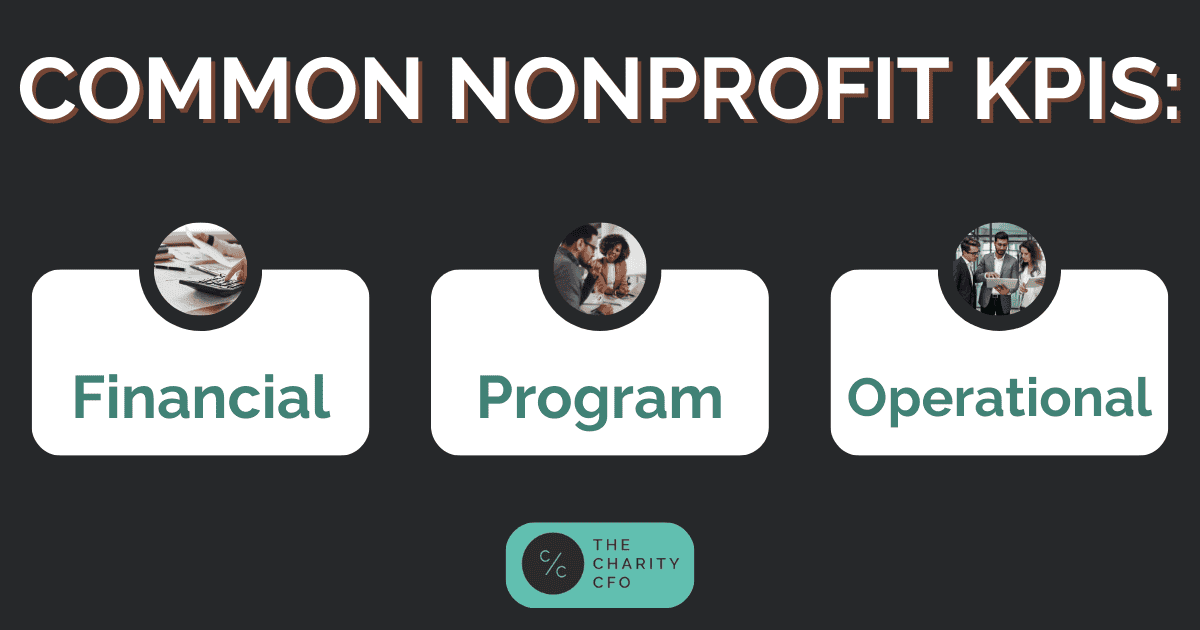
Your organization will likely want to track a variety of KPIs to measure–and improve–performance. Some of the most common KPI categories for nonprofits include financial, program-related, and operational metrics.
Financial KPIs
Financial KPIs are often some of the most important indicators of the health of an organization. Consider financial KPIs such as:
- Total Revenue Growth Rate: This metric tracks the percentage increase or decrease of your total revenues over a specified timeframe.
- Program Expense Ratio: This KPI tracks the efficiency of your programs and services by measuring the proportion of total expenses spent on programs.
- Donor Retention Rate: A donor retention rate measures the percentage of donors who continue to support your organization over time and can be used to track donor relations and satisfaction.
Program KPIs
How can you tell if your programs and services are making an impact in your community using data? By implementing program KPIs like:
- Number of Beneficiaries Served: This straightforward KPI quantifies your organization’s reach by measuring the total number of individuals benefiting from programs.
- Client Satisfaction Rate: This metric measures the level of satisfaction among program participants or clients using the services your organization provides.
Operational KPIs
Operational KPIs help you determine the efficiency and effectiveness of your day-to-day operations. These KPIs are especially good tools for tracking employee and volunteer satisfaction.
- Volunteer Retention Rate: The KPI tracks the percentage of volunteers who continue to engage with your organization over time, helping you see if your volunteer management programs retain volunteers.
- Employee Turnover Rate: Your employee turnover rate measures the rate at which employees leave your organization. A high turnover rate could indicate unhappy employees.

Choose Your Nonprofit KPIs
Defining your nonprofit KPIs is an essential step to making strategic, data-driven decisions. You’ll want to choose KPIs that reflect your mission, are relevant to stakeholders, and have measurable data you can use to track them.
Financial KPIs, in particular, are some of the most important tracking metrics for any organization. The team at The Charity CFO can help you analyze your financial data and find usable metrics for KPIs. As financial professionals specializing in nonprofit accounting, we know nonprofits’ unique financial challenges.
Contact us today to learn more.
No time to read this article now? Download it for later.