Fragmented databases and outdated tracking methods hold organizations back from making confident financial decisions. Discover four practical strategies — from consolidating your tech stack to using predictive analytics — that turn scattered data into a clear, actionable financial picture.
Ninety-five percent of nonprofit leaders report full-blown burnout, and one in three is considering leaving the sector. Nonprofit executive Annette Eros argues the usual fixes, more rest, better boundaries, miss the real issue: chronic underinvestment in systems and infrastructure that leaves leaders absorbing the gap. She shares her ANCHOR Method for rebuilding organizational structure, and why “capacity building training” often just adds more weight to an already overloaded leader instead of solving the underlying problem.
Nonprofit leaders keep asking if AI will replace their accountant or CFO. The honest answer: no — but it’s changing what the role looks like. Here’s where AI is genuinely helping today, where it still falls short, and how finance leaders can shift from reactive reporting to proactive strategy.
Volunteer grants let companies turn employee service hours into unrestricted cash gifts for your nonprofit — but most organizations miss out simply because they never ask supporters where they work.
A $15.6 million deficit at a St. Louis utility has city leaders eyeing a costly forensic audit — but Charity CFO founder Tasha Anderson says fraud is rarely the real story. Here’s what usually causes a finance function to go dark, and the three reports that catch it before it becomes a crisis.
Discover five healthcare nonprofit accounting strategies to optimize your revenue cycle, centralize financials, and improve patient payment experiences.
Brandon Peacock built Hit the Ground Running around his own story as a trauma survivor — which made him the organization’s biggest asset and its biggest bottleneck. He and podcast host Tosha Anderson talk about what it actually takes to build a nonprofit that can run without its founder in the room.
Board members tuning out during financial reviews isn’t disinterest — it’s a presentation problem. Learn four practical strategies to turn dense financial reports into clear, engaging conversations that drive real board strategy.
When a team member isn’t delivering, the instinct is to question the hire. But according to HR expert Tiffany Slater, 70-75% of the time the real issue traces back to leadership. Here’s what nonprofit leaders need to look at first.
Burnout in the nonprofit sector gets a lot of attention. But neurodivergent burnout is a different conversation entirely. Here’s what leaders need to understand before it’s too late.
Most nonprofits think they have a CFO function — but really have a strong accounting function. Learn the difference between a traditional and strategic nonprofit CFO, why the shift is happening now, and how to know which model your organization needs.
Nonprofit accounting teams are stretched thin — but AI is changing that. From faster month-end close to predictive forecasting, explore 7 practical ways artificial intelligence is improving nonprofit finance and freeing CFOs to focus on strategy.
Most nonprofits don’t need more accounting — they need better financial leadership. Discover what a nonprofit CFO actually does, how the role differs from a nonprofit accountant, and how AI is accelerating the shift toward strategic finance.
AI isn’t replacing the nonprofit CFO — it’s raising the bar. Learn how artificial intelligence is shifting the CFO role from financial reporting to strategic decision support, and what that means for your organization.
Most nonprofit leaders have sent a press release into the void — crafted the announcement, hit send, and heard nothing. Here’s what journalists actually want, and how to make sure your next pitch gets noticed.
Discover how scenario planning can help your nonprofit navigate economic uncertainty. Learn to build agile financial strategies that future-proof your mission.
Burnout is becoming the norm in nonprofit leadership, but sustainable leadership is possible. Learn the weekly habits, operational shifts, and boundary-setting strategies nonprofit executives can use to reduce overwhelm, strengthen their organizations, and lead more effectively long term.
Budgeting isn’t just a spreadsheet. It’s a strategic tool that reveals whether your nonprofit is truly aligned with its mission.
This blog breaks down how to move beyond static budgets and start using them as a roadmap for decision-making, clarity, and impact. If your budget isn’t guiding your organization, it’s time to rethink how you’re using it.
Nonprofits often get stuck in a cycle of reactive fundraising, constantly chasing the next grant or campaign. Learn how shifting from survival mode to clarity and impact can help your organization build sustainable funding.
Advocacy in the nonprofit world often gets narrowed down to policy, awareness campaigns, or boardroom pitches. But as Courtney Johnson of Culinary Care reminds us, the most powerful kind of advocacy happens one relationship at a time—starting with yourself.
On this episode of A Modern Nonprofit Podcast, host Tosha Anderson sits down with Courtney Johnson, who founded Culinary Care at just 23 years old after losing her father to cancer. What began as a simple act of service—delivering a hot, restaurant-prepared meal to one patient—has grown into a mission-driven nonprofit serving cancer patients across regions.
This isn’t a story about scaling overnight. It’s a story about finding your people, listening to your community, and building a nonprofit that meets a need no one else was addressing.
Advocacy Starts With Listening
Courtney didn’t launch Culinary Care with a perfectly polished plan. She started with a single goal: to give comfort and nourishment to cancer patients in outpatient care—people who often spend hours at treatment centers with no access to meals.
The turning point? A handwritten four-page letter from the first patient she served. That one story opened Courtney’s eyes to the emotional, physical, and financial weight patients carry—and helped her realize she wasn’t just delivering meals. She was delivering connection, dignity, and care.
That’s where advocacy truly began—not with a pitch deck, but with presence.
Ignore the Naysayers. Find Your People.
As a young founder, Courtney faced skepticism at nearly every turn. Lawyers, donors, and even friends questioned her decision to start a nonprofit with no culinary background, no logistics team, and no fundraising experience.
But instead of internalizing the doubt, she used it as fuel. “Every donation is like a vote,” she says. “It’s someone saying, ‘I believe in this mission—and in you.’”
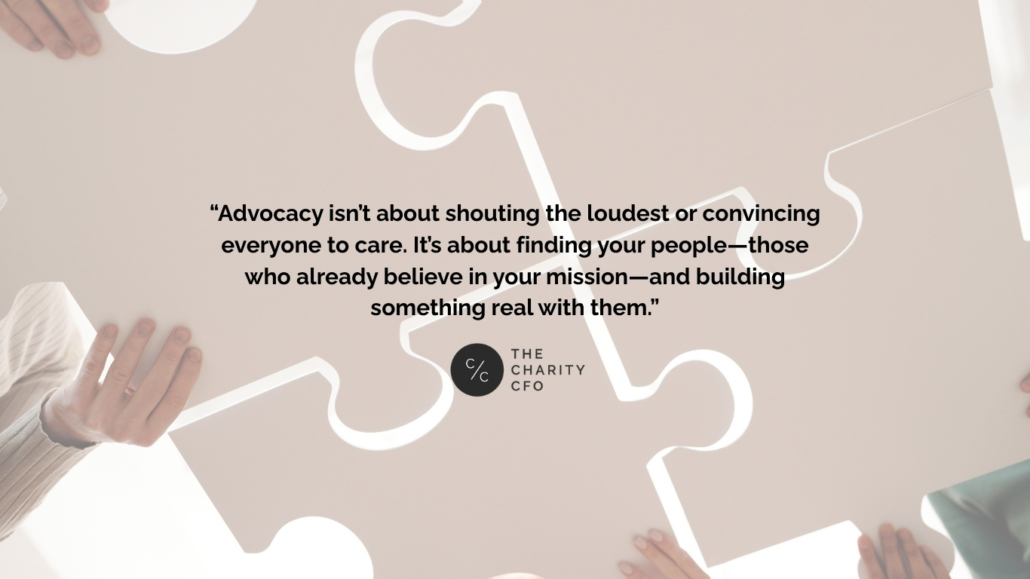
Rather than trying to win everyone over, Courtney focused on finding the people who already believed in what she was building. From patients to donors to hospital staff, she built a community rooted in trust, transparency, and shared values.
This is where most nonprofit founders get stuck. They pour energy into convincing the wrong audience instead of connecting with the right one. As Courtney puts it: “You’re not here to change someone’s mind who doesn’t believe in your mission. You’re here to find the people who already do—and might not know you exist yet.”
Start Small. Stay Aligned.
Courtney didn’t start with a massive donor list or a staff of 10. She worked full-time, delivered meals on her lunch break, and relied on family and friends to help grow the mission—one meal at a time.
Eventually, she expanded that model through intentional, mission-aligned fundraising. Instead of a traditional gala, she launched a Corporate Cook-Off—a unique, branded experience that aligned with her audience and her mission. Ten years later, it’s still their most successful annual event.
Her advice to founders? Start with your strengths. Don’t mimic what other nonprofits are doing if it doesn’t make sense for your mission. Get creative, stay authentic, and build with sustainability in mind.
Real Advocacy = Real Alignment
One of the most compelling parts of Courtney’s journey is how Culinary Care stayed operational during the COVID-19 shutdown. When hospitals locked down and restaurants closed, she turned to her community, raised emergency funds, and delivered meals through creative new systems—with nurses stepping in to help.
That’s what advocacy looks like at its best: mutual mission alignment. When you partner with people who care about the same outcomes, advocacy isn’t a hard sell—it’s a shared effort.
Advocacy Is a Relationship
This episode isn’t just for nonprofit founders—it’s for anyone trying to lead with purpose and grow something meaningful. Courtney’s story reminds us that advocacy is less about shouting louder and more about showing up, listening, and building from trust.
If you’re a nonprofit leader looking for direction, motivation, or just a reminder that you’re not alone in this work—this one’s for you.
The Charity CFO is an accounting partner that truly understands nonprofits. Our team knows the missions that drive you, the obstacles that challenge you, and the dedication your job demands. We “get” nonprofits, because nonprofits are all that we do. If you need help with your accounting and bookkeeping, let’s talk.
Most nonprofits don’t have a branding problem—they have a clarity problem.
In our latest episode of A Modern Nonprofit Podcast, Steven Picanza of ANEWbrand joins Tosha Anderson to talk all things branding, verbal identity, and the art of not overloading your homepage.
Your Website Is Trying to Talk to Everyone
Too many nonprofits try to speak to all their audiences at once:
Donors
Program participants
Board members
Staff
Volunteers
The result? Websites that feel more like mazes than invitations.
When your homepage tries to do everything, it often does nothing well. People don’t know where to click, what matters most, or how to take action. And when there’s confusion, visitors disengage.
Function Over Flash
Branding doesn’t have to be flashy. In fact, the most effective nonprofit brands are grounded in function—not flair.
Think of your brand like a kitchen. If it’s cluttered, outdated, and confusing, no one wants to spend time there. The same goes for your website, social media, or marketing materials. They should feel welcoming, efficient, and easy to navigate.
Start with Verbal Identity
So how do you fix a cluttered brand? It starts with verbal identity—your voice, tone, and the words you use to communicate your mission.
Getting clear on how you sound helps you stay consistent across every touchpoint—from your homepage to your donation forms to your elevator pitch. When your language is clear, your message becomes memorable.
Your Brand Should Work Internally, Too
Verbal identity isn’t just for donors—it’s for your team.
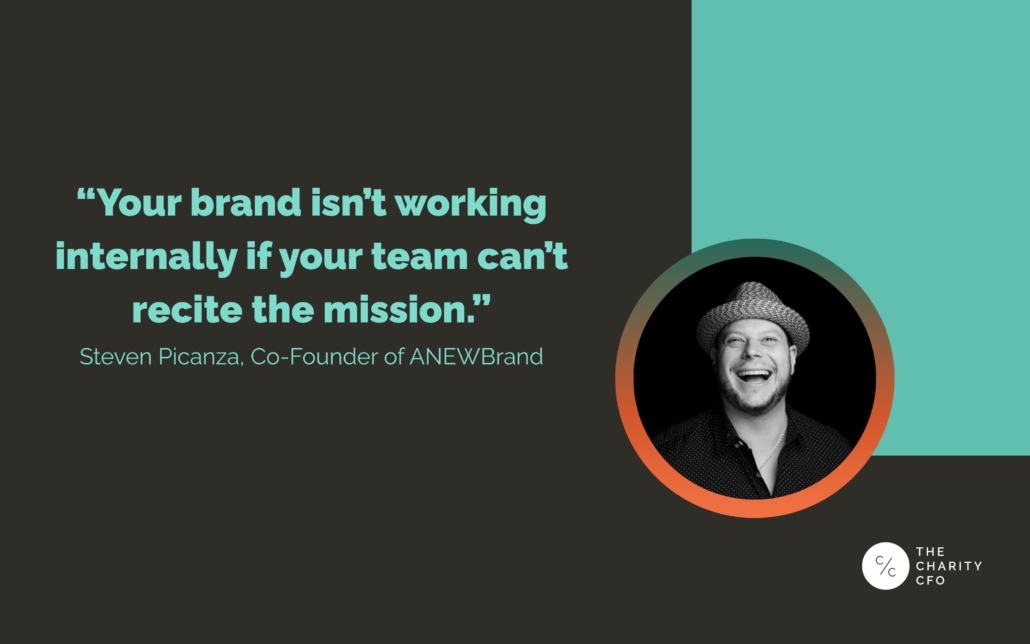
Every staff member, board member, and volunteer should be able to recite your mission on command. If they can’t, your brand isn’t working internally. And if it’s not working internally, it won’t hold up externally either.
A strong brand creates alignment. It brings everyone on the same page with your purpose, values, and next steps.
Your Brand Attracts More Than Donors
Branding isn’t just about fundraising. It also impacts your ability to attract:
Mission-aligned staff
Skilled volunteers
Community partners
In today’s nonprofit landscape, where funding is shifting from government to private sources, your brand needs to do more than inspire—it needs to convert.
Don’t Wait Until It’s Broken
You don’t have to wait for your brand to be broken—or outdated—to take action.
Learn about simple tools you can use like:
Stakeholder surveys
External brand consultants
These can help you gather honest feedback and make strategic improvements.
Branding doesn’t have to mean starting over. Most of the time, it’s an evolution—not a revolution.
Clarity Is the New Competitive Edge
In a crowded digital world, clarity is what cuts through.
Get clear on who you are. Get clear on who you’re talking to. And most importantly—get clear on what you want them to do next.
The Charity CFO is an accounting partner that truly understands nonprofits. Our team knows the missions that drive you, the obstacles that challenge you, and the dedication your job demands. We “get” nonprofits, because nonprofits are all that we do. If you need help with your accounting and bookkeeping, let’s talk.