Budgets for Nonprofits: Get ready for 2023
Financial planning and budgeting are vital for the success and sustainability of any nonprofit organization.
Without a clear understanding of income and expenses — it’s impossible to deliver on your organization’s mission, vision, and goals effectively.
That’s why it’s important to start thinking about your budget for 2023 now. By taking the time to assess your current financial situation and map out your anticipated income and expenses for the year ahead, you can make sure that your nonprofit is on track to meet its goals.
Budgeting should go beyond simply tracking money in and money out.
A well-crafted budget can be a powerful tool for decision-making, helping you to prioritize spending in line with your strategic goals. It can also be a valuable communication tool, providing clarity for staff, volunteers, and donors about where their money is going and how it’s making an impact.
A nonprofit budget helps your organization:
- Stay fiscally healthy
- Allocate resources
- Set spending priorities
However, if you’re not careful, it’s only a document.
Only through regularly reviewing and updating a budget does it accurately reflect your nonprofit’s current financial situation. Using the budget, not only creating it, gives you a clear roadmap to follow and ensures your organization stays within the precincts of its tax-exempt status.
Intro to Budgets for Nonprofits
Budgets differ greatly between nonprofits and for-profits. The biggest distinction is that nonprofits don’t exist to make a profit; they exist to further their missions. Therefore, their budgeting process must be geared towards achieving mission-related goals, rather than maximizing financial gain.
A nonprofit budget is typically a planning document that shows how the organization plans to raise and allocate its money to support its programs and operations. The budget will include both income and expenses and will be based on the organization’s strategic plan.
The budgeting process should involve all members of the organization, from the Board of Directors and committees, to the staff and volunteers. Everyone should have a clear understanding of the organization’s financial situation and be able to provide input on where money should be spent.
The budget should be reviewed and updated regularly, at least on an annual basis. As your organization’s financial situation changes, so too should your budget.
There are two main types of nonprofit budgets: static and dynamic.
- A static budget is a detailed plan that uses predicted amounts for a given period. It does not change regardless of deviations in revenue and expenses and is typically used for short-term planning. A static budget is ideal for small nonprofits with simple financial structures.
- A dynamic budget is more flexible and can be adjusted to reflect changes in income and expenses. It allows nonprofits to respond quickly to fluctuations in their funding and better manage their resources. A dynamic budget is a good choice for larger nonprofits with more complex financial structures.
There is no rule that a budget must be one type or the other; it can be a mix of both. The important thing is to use the type of budget that makes the most sense for your organization and its specific needs.
During your budgeting process, you should constantly monitor your situation and make adjustments as needed. The goal is to have a budget that is realistic and achievable so that you can stay on track and deliver on your mission.
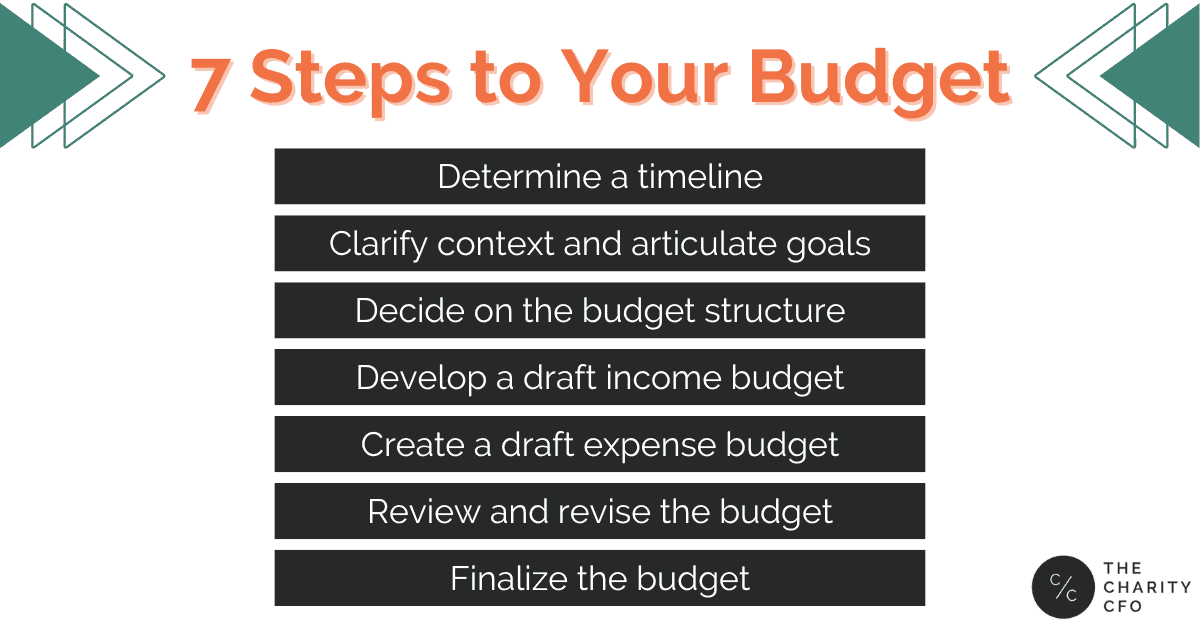
7 Steps to Your Budget
1. Determine a timeline
We are approaching the end of the year, so you may want to start thinking about your budget for 2023 now. By taking the time to assess your current financial situation and map out your goals, you can ensure that your budget is well-crafted and accurate. Allow time for review and discussion, set a target date for board approval, and ensure that everyone understands the budget and their role in it.
2. Clarify context and articulate goals
Assess the current alignment of organizational values, reflect on successes and failures, identify opportunities and challenges, and set goals for the upcoming budget year. These goals should be specific, measurable, achievable, relevant, and time-bound (SMART). Input from various stakeholders will be critical at this stage. The budget should reflect the collective vision of the organization, and everyone should have a chance to provide input.
3. Decide on the budget structure
What is the primary purpose of your budget? Is it a monitoring tool, a funder compliance roadmap, or a blueprint for change? Your answer will determine the structure of your budget. A results-based budget, for example, focuses on outcomes rather than inputs and is often used to demonstrate impact to funders.
On the other hand, an activity/program-based budget is more commonly used to track expenses and income related to specific programs. Other budget structures you can adopt include time-based, source-based, impact-based, and cash-flow budgets.
4. Develop a draft income budget
This is where the rubber meets the road. Once you have decided on the structure of your budget, you can begin to fill in the details. Begin with a list of all income, including both one-time and recurring items. Project income for the upcoming year based on past performance, current trends, and any known changes. If your organization is expecting any grant funding, make sure to include the conditions of the grant in your budget.
5. Create a draft expense budget
Articulate the direct and indirect costs associated with each goal. Indirect costs, also known as overhead costs, are those that cannot be assigned to a specific program or activity. They include items such as rent, utilities, and administrative salaries and should be allocated in a fair and reasonable manner. Once all expenses have been accounted for, compare your total income to your total expenses to ensure that you are not overspending.
6. Review and revise the budget
Discuss potential risk areas, including any potential changes in funding, unanticipated expenses, or unrealistic income projections. Make any necessary changes to the budget and get feedback from key stakeholders. Create a consolidated budget spreadsheet that addresses values, goals, and named priorities. Revise the budget to make sure that it is achievable and realistic.
7. Finalize the budget
Present the budget to the board for approval, get sign-off from the executive director, and distribute the budget to staff. Make sure that everyone understands the budget and their role in achieving the organization’s goals.
Ensure that all decision-making processes and rolling forecasts are documented for easier monitoring. Ensure that you review and update the budget regularly to account for any changes in funding, new programs, or unanticipated expenses.
Specialized Nonprofit Budgeting Help
Budgeting for a nonprofit organization can seem daunting, but it doesn’t have to be. The most important aspect is to identify all possible sources of income and expenses. Once you have a clear understanding of the organization’s finances, you can begin to develop a budget that meets the needs of the organization.
Having a well-thought-out strategic forecast and budget can help your nonprofit gain better visibility with donors and funders, manage expenses more effectively, and make sound financial decisions. These are all important factors in ensuring the long-term sustainability of your organization.
But with all the moving parts of a nonprofit organization, it can be difficult to know where to start. That’s where we come in. Our team at The Charity CFO has extensive experience in nonprofit budgeting and can help you develop a budget that meets the specific needs of your organization. Having worked with over 150 nonprofits, we understand the challenges you face and can offer tailored solutions to help you overcome them.
Contact us today to learn more about our nonprofit budgeting services. We’ll be happy to discuss your specific needs and provide a no-obligation proposal outlining how we can help you achieve your goals and mission.