
Financial Reports to Share with Nonprofit Board
No time to read this article now? Download it for later.
Transparency and accountability are two of the most important factors in nonprofit accounting. Donors, the board of directors, and the public all want to know what your organization does with the funds it brings in. Being transparent in your nonprofit accounting helps build trust in your organization.
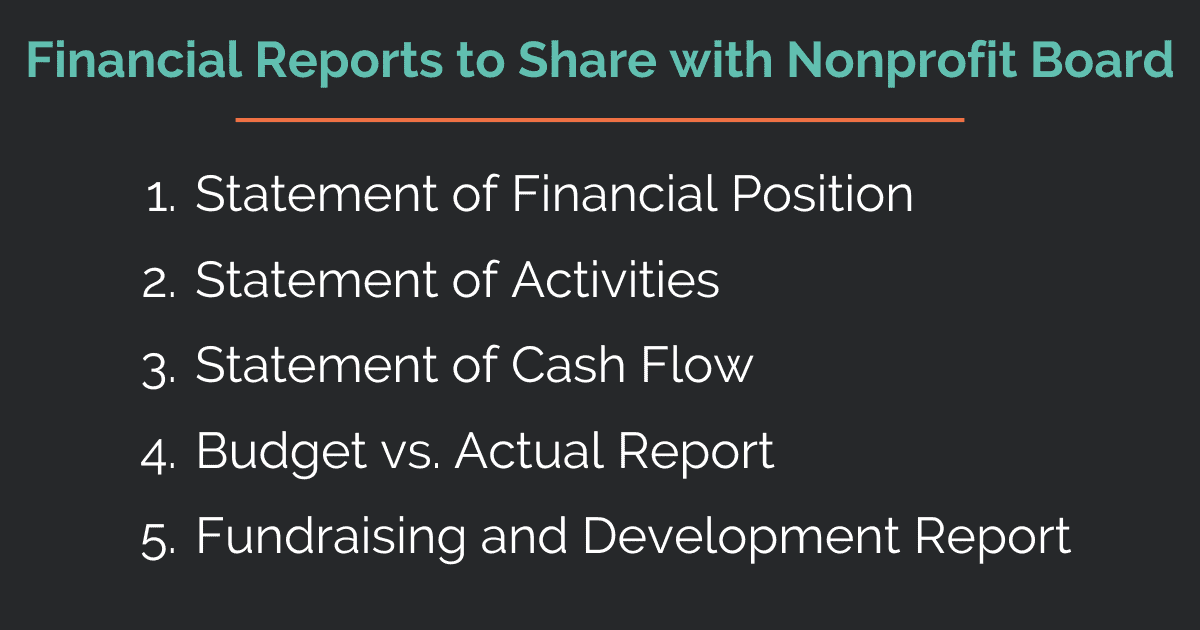
But what financial reports are most important to build that trust through transparency with your board of directors? There are five main financial reports you may want to consider when presenting financial data to your board of directors, including:
- Statement of Financial Position
- Statement of Activities
- Statement of Cash Flow
- Budget vs. Actual Report
- Fundraising and Development Report
1. Statement of Financial Position
Your statement of financial position is a financial report that provides an overview of the organization’s financials at a specific point in time. For-profit businesses also call the statement of financial position a balance sheet, and many nonprofits do the same.
Your balance sheet is a lot like a health chart for a medical patient–it shows the current overall financial health of your organization. Balance sheets show details on how much money and assets your organization has as well as what it owes to others. Your nonprofit balance sheet will typically have three main components:
- Assets: What your organization owns
- Liabilities: The amount your nonprofit owes
- Net Assets: The value of your organization, or your assets minus your liabilities
Providing your board of directors with a statement of financial position can help them better understand the financial health, stability, and liquidity of your organization.
2. Statement of Activities
More commonly known as an income statement, the statement of activities report summarizes your organization’s revenues and expenses over a specific period. Generally, this report is provided monthly, quarterly, or annually. Organizations that have a high amount of revenue and expenses may want to provide multiple timeframes for their board of directors.
The statement of activities shows your board of directors how much revenue the organization has earned and the amount of expenses incurred over the specified time. The report also details whether your organization has generated a surplus or deficit during the period. Key components of the report include:
- Revenue: Contributions, grants, program and service fees, and any other income
- Expenses: Program expenses, payroll and staffing costs, fundraising events
- Changes in Net Assets: Whether your organization has a surplus or deficit
An income statement report makes it easier for your board of directors to track revenue and expenses over time, which can help make long-term financial decisions.
3. Statement of Cash Flow
An organization’s statement of cash flow report tracks the inflow and outflow of cash over a set timeframe. The report is generally broken into three parts:
- Operating Activities: Your day-to-day cash transactions including paying employee salaries
- Investing Activities: Purchases and sales of an organization’s assets, such as buying new equipment
- Financing Activities: Loans, grants, and donations to the organization
Proving your board with a statement of cash flow helps them better understand the ongoing cash flow management of the organization. You can the board can also use the report to look for opportunities to maximize cash flow and optimize cash flow management to make the organization more resilient to unexpected changes in the nonprofit’s finances.
4. Budget vs. Actual Report
A budget-to-actual report compares an organization’s actual financial performance with its budgeted figures. This report highlights the differences between budgeted and actual revenues and expenses.
Your board of directors can use this report to better assess the organization’s financial discipline and operational efficiency. Organizations with major variances between their budget and actual may need to adjust their cash flow and expense management practices. Reviewing a budget vs an actual report also helps your organization identify discrepancies such as errors in accounting.
5. Fundraising and Development Report
A fundraising and development report focuses on the organization’s fundraising efforts and donor contributions. This report shows information on funds raised through various campaigns and events. It also generally includes data on donor acquisition and retention rates.
Your board of directors can use a fundraising and development report to evaluate the effectiveness of fundraising strategies. The report can also help show the organization’s financial sustainability through donor retention rates.
Fundraising and development reports are great tools for planning future fundraising ideas for the organization. You can use the report as a starting point to see what fundraising efforts your donors respond to best.
Preparing Financial Reports for a Nonprofit Board
These five financial reports can provide your board of directors with an accurate picture of your organization’s financial health. Depending on your organization, some of your reports may be more or less in-depth, and some organizations may not need each report for every board meeting.
Working with an experienced nonprofit accounting firm, like the Charity CFO, is an easy way to ensure you’re providing the right reports for your board. The Charity CFO team specializes in nonprofit accounting and can help you navigate the complexities of financial reporting for your organization. We’ll help you create a nonprofit accounting system that uses technology to automate some aspects of reporting, saving time over manual processes.
Need help setting up a financial reporting process? Contact us today to find out how we can help!
No time to read this article now? Download it for later.