• NEWSLETTER
    • Schedule a Call
    The Charity CFO
    • Services
      • Bookkeeping
      • Accounting
      • Grant Management
      • Budgeting & Forecasting
      • Audit Assistance
      • System Migration & Tech Integration
      • Tax Preparation
    • Who We Serve
      • Human & Social Services
      • Education & Workforce Development
      • Youth & Community Development
      • Health & Human Services
      • Legal, Advocacy & Civil Rights
      • Religious & Faith-Based
      • Arts, Cultural & Environmental
      • Fundraising & Philanthropy
      • Animal Rights and Welfare
    • About
      • Our Team
      • Our Process
    • Resources
      • Blog
      • Podcast
      • Testimonials
      • Newsletter
    • Careers
    • Menu Menu

    Nonprofit Budgeting Best Practices

    Nonprofit budgeting best practices are often the difference between success and failure for the organization.

    Budgeting is a crucial element of understanding the financial health of your organization. Budgeting for nonprofits is very different from for profits, and a well-developed budgeting process can provide meaningful insight into the strength of your organization and your progress toward your mission. It also allows for better communication and transparency with employees who are striving for the same goals.

    While nonprofit budgeting can seem daunting and complex, it doesn’t have to be. We’ve outlined some nonprofit budgeting best practices to enhance your budgeting skills and help you strategically and effectively plan your programming and reach your goals.
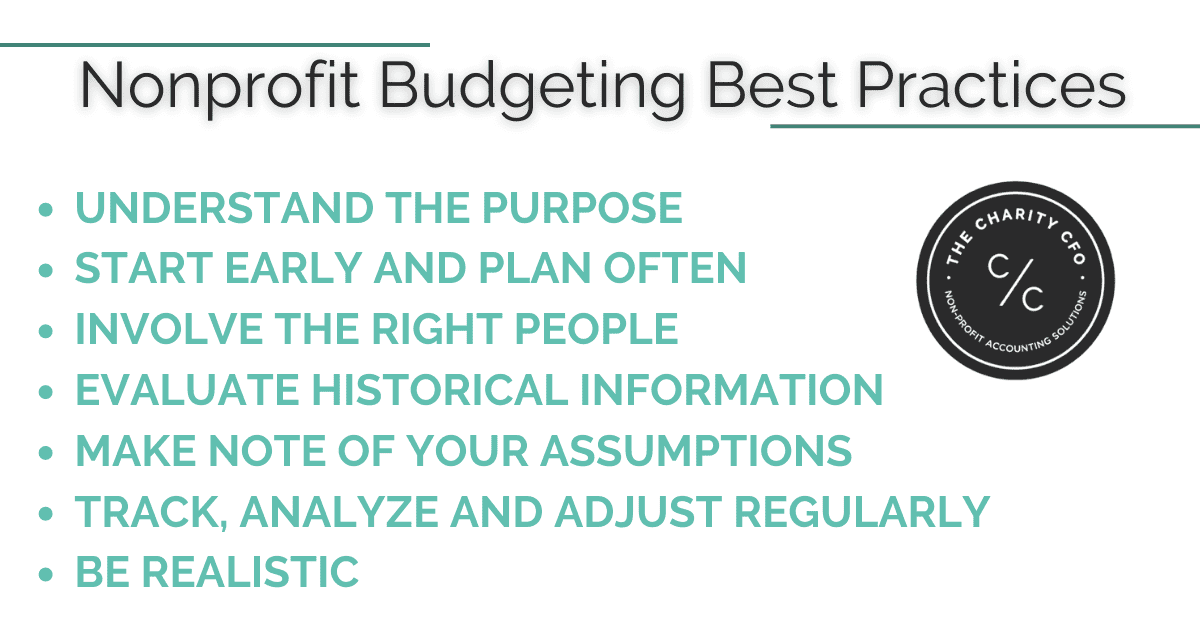
    Nonprofit Budgeting Best Practices

    Understand the purpose 

    Understanding the purpose of your organization and, by extension, your budget is the most important thing you can do when creating your annual budget. What is your mission and what goals and programs are going to help you get there?

    As nonprofits must specifically account for the use of every dollar, keeping your purpose as your north star will help you tremendously when creating your budget. From there you can further determine how the budget will be used, who needs to be included, and how you can utilize the budget to make strategic decisions moving forward. Knowing the answers to these questions will help you focus and create an effective budget.

    Start early and plan often

    Planning is key. It takes time to get a budget right. Starting your budgeting process early will save a lot of headaches. By thinking about your budget early on, you can identify key people in your organization to provide information regarding the data, activities, income and expenses necessary to create a nonprofit operating budget.

    Put calendar invites in place to begin discussions, ensuring that when the time comes to compile the budget and present to the Board, proper thought and care has been put into the assumptions used.

    Involve the right people

    Another benefit to planning early is that you have time to make sure the right people are properly included. In addition to the Board and leadership, it’s important to include other key employees in the process. These are usually the ones who have their hands on the pulse of the organization. They operate in the day to day and are able to provide insight into how specific programs and initiatives are going.

    By being transparent and including key employees in the process, you can identify areas of improvement and pain points, creating a more effective budget. This also provides opportunity to discuss with the Board strategic opportunities, making the most use of all the time you’ve spent creating your budget.

    Evaluate historical information 

    If you’ve been operating for a while, then you should already have a great start in creating your nonprofit’s budget. Using historical information is the best starting point to begin your budgeting process. Take the information from prior year actuals and expand upon it, using the takeaways gathered from key employees. By combining historical data with real time assumptions you are in a great place to pull together a first draft of your budget.

    If you’re starting from scratch, check out our Beginner’s Guide to Nonprofit Budgeting.

    Make note of your assumptions

    Using historical information is a great place to start, but it’s important to keep track of what assumptions you are using to calculate the actual number you are presenting. Tracking these assumptions makes it easier to identify what happened when actual numbers don’t match your estimates. Understanding these assumptions makes budget analysis and strategic decision-making much easier.

    Track, analyze and adjust regularly

    Once you’ve created a budget, it’s important that you don’t just sit on it until next year. Take the time to track your budget to actuals and analyze the variances monthly. Looking at your assumptions can be helpful in explaining any discrepancies, as you now have more information regarding how the year is progressing. Variances should be expected. It’s wise to adjust your budget based on actuals and create an updated projection for the remainder of the year. Budgets are only as good as the information available and, as the year goes on, you gain more insight into operations.

    Be realistic 

    While the last few years have seen huge upticks in donor giving, it’s still important to remain realistic. With over 1.5 million nonprofits in the US alone, there’s still steep competition. Understanding your organization’s place in the current environment, knowing your donor profile, and setting realistic goals, both financially and programmatically, puts you on more solid ground, ensuring that your organization can continue doing good now and in the future.

    These nonprofit budgeting best practices are high level and we know there’s a lot that goes into nonprofit budgeting. If you’re looking for help in creating an efficient and effective budget, The Charity CFO has resources and professionals to support you, so you can focus on your mission.

    📬 Join Our Newsletter

    https://go.thecharitycfo.com/l/995872/2025-02-24/6ldn1

    No time to read this article now? Download it for later.

    Popular
    • What is Financial Oversight?
      Nonprofit Accounting Tips, Tools, & Tricks Your Organization...January 22, 2020 - 4:23 pm
    • nonprofit fundraising strategies
      Do Nonprofits Pay Taxes? This is What You Should KnowJanuary 22, 2020 - 4:31 pm
    • The Charity: 6 Common Tax Mistakes that Non-Profits Mak...January 22, 2020 - 4:55 pm
    • We’re Hiring!January 29, 2020 - 9:31 pm

    Categories

    • 501c3
    • Accounting
    • Accounting, Budgeting & Leadership Strategy
    • Accounting|Audit|CharityCFO
    • Accounting|Audit|Grants|Nonprofit|Reporting|Taxes
    • Accounting|Audits|Expenses|Fundraising|Grants|Nonprofit|Operations|Reporting
    • Accounting|Board Management|Leadership|Nonprofit|Operations
    • Accounting|CharityCFO
    • Accounting|Expenses|Grants|Nonprofit|Reporting
    • Accounting|Fundraising|Grants
    • Accounting|Leadership|Nonprofit
    • Audit
    • Audits
    • Board Management
    • CFO Responsibilities
    • CFO Services Transition
    • CharityCFO
    • CharityCFO|Nonprofit
    • Compliance and Taxation
    • COVID-19 Response
    • Cryptocurrency
    • Diversified Funding Models
    • Expenses
    • Fractional & Outsourced Executive Services
    • Fundraising
    • Grants
    • Investment
    • Leadership
    • Leadership|Nonprofit|Operations
    • Miscellaneous
    • Nonprofit
    • Nonprofit Financial Leadership
    • Nonprofit Financial Maturity
    • Nonprofit Financial Operations
    • Nonprofit Revenue Strategies
    • Nonprofit Revenue Strategy
    • Nonprofit Strategic Leadership
    • Operations
    • Payroll
    • Reporting
    • Taxes
    • Team Contribution
    • Team News
    • Trending
    • Uncategorized
    Left Aligned Cfo Logo White

    Who We Are

    About Us

    Our Team

    Testimonials

    Careers

    Terms and Conditions

    How We Help

    Bookkeeping

    Accounting

    Grant Management

    Budgeting & Forecasting

    Audit Assistance

    System Migration & Tech Integration

    Tax Preparation

    Get in Touch

    1310 Papin Street, Suite 300

    St. Louis, MO 63103

    (314) 390-0220

    [email protected]

    Website by Abstrakt Marketing Group ©
      • Sitemap
      • Privacy Policy
      Link to: Understanding the Nonprofit Statement of Cash Flows Link to: Understanding the Nonprofit Statement of Cash Flows Understanding the Nonprofit Statement of Cash Flows Link to: Nonprofit treasurer duties: Where you should focus Link to: Nonprofit treasurer duties: Where you should focus Nonprofit treasurer duties: Where you should focus
      Scroll to top Scroll to top Scroll to top

      This site uses cookies. By continuing to browse the site, you are agreeing to our use of cookies.

      AcceptLearn more

      Cookie and Privacy Settings


      How we use cookies

      We may request cookies to be set on your device. We use cookies to let us know when you visit our websites, how you interact with us, to enrich your user experience, and to customize your relationship with our website.

      Click on the different category headings to find out more. You can also change some of your preferences. Note that blocking some types of cookies may impact your experience on our websites and the services we are able to offer.

      Essential Website Cookies

      These cookies are strictly necessary to provide you with services available through our website and to use some of its features.

      Because these cookies are strictly necessary to deliver the website, refusing them will have impact how our site functions. You always can block or delete cookies by changing your browser settings and force blocking all cookies on this website. But this will always prompt you to accept/refuse cookies when revisiting our site.

      We fully respect if you want to refuse cookies but to avoid asking you again and again kindly allow us to store a cookie for that. You are free to opt out any time or opt in for other cookies to get a better experience. If you refuse cookies we will remove all set cookies in our domain.

      We provide you with a list of stored cookies on your computer in our domain so you can check what we stored. Due to security reasons we are not able to show or modify cookies from other domains. You can check these in your browser security settings.

      Other external services

      We also use different external services like Google Webfonts, Google Maps, and external Video providers. Since these providers may collect personal data like your IP address we allow you to block them here. Please be aware that this might heavily reduce the functionality and appearance of our site. Changes will take effect once you reload the page.

      Google Webfont Settings:

      Google Map Settings:

      Google reCaptcha Settings:

      Vimeo and Youtube video embeds:

      Accept settingsHide notification only
      X

      Help Center

      Running a Nonprofit Is Hard. We’re Here to Help.

      Receive expert tips, financial guidance, and real-world advice—straight delivered to your inbox.

      Subscribe
      Discover The Charity CFO Financial Blueprint: Tips from The Best Nonprofit Organizations
      Download Our Playbook