Clocking in and Out: Nonprofit Payroll Issues
Clocking in and out each day is a fact of life for tens of millions of workers around the country. But it’s often not the case at many charities and nonprofits, which can gauge an employee’s value by their impact, not just their hours spent in the office.
Still, there are some situations where more precisely recording when (or where) you’re working can be beneficial to the organization.
Let’s take a closer look at how and when it’s best used.
Common Nonprofit Payroll Issues
Nonprofit Payroll issues can present a wide variety of problems, several of which can potentially be helped by implementing a clocking-in and out procedure.
These include both under- and overstaffing. For the former, tracking time on the job can be helpful to ensure enough people are contributing and preventing overworked employees. For the latter, a time clock can provide firm data that will help reduce unnecessary labor costs. Both of these are vital to operating in the most efficient way possible, allowing the most funding and effort to go toward the nonprofit’s mission.
In other cases, it may not be up to your organization. Grant-funded programs often require employees to track their time to ensure money is being used appropriately. The minor inconvenience of clocking in and time tracking can be far outweighed by the financial benefits these programs offer, making it a no-brainer decision.
Unfortunately, time-related payroll issues aren’t the only ones confronting many organizations. One of the most significant is simple employee turnover. High turnover usually leads to higher administrative costs for onboarding and other training needs. It’s among the reasons why it’s so critical to find the right-sized staff and keep good employees for the long term.
Situations When Payroll Issues Make Clocking In and Out Necessary
There are a variety of circumstances where clocking in and out could become necessary for the sustainable growth of the organization.
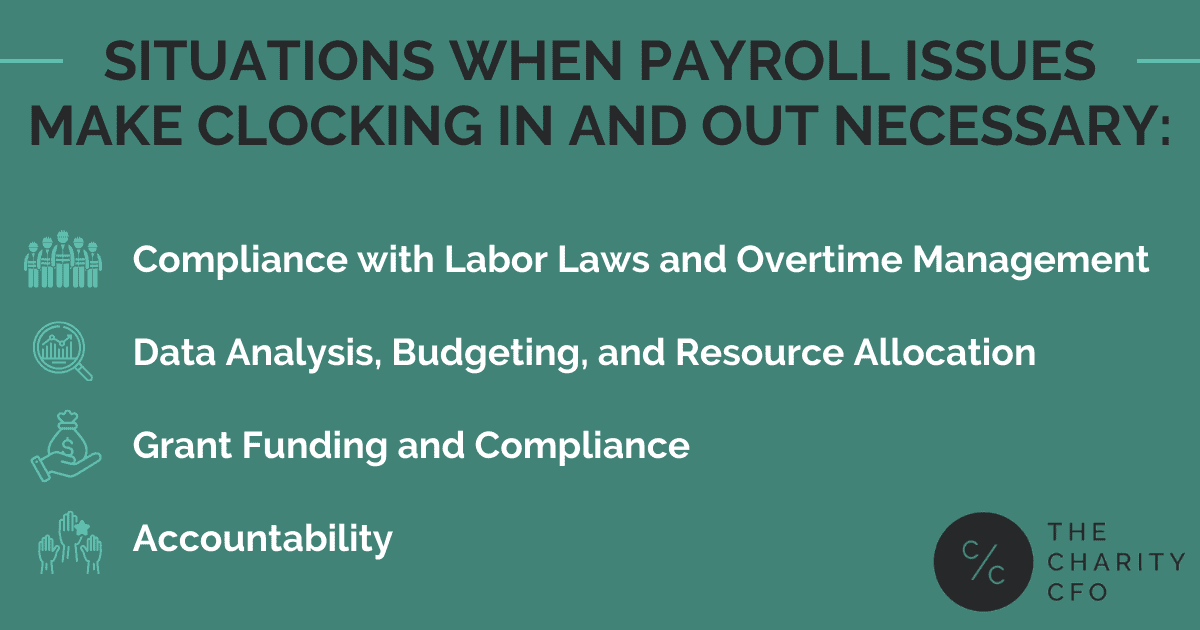
1. Compliance with Labor Laws and Overtime Management
Like any other employer, nonprofit organizations are subject to labor laws and regulations. With accurate time-tracking, it’s easier to stay compliant with these laws.
This especially applies when managing overtime. There is a lot of work to be done at nonprofits and many times hourly workers are required to work overtime. When clocking in and out is required, it helps manage these hours and ensure the employees are being compensated correctly.
When determining which employees should be paid for overtime, a nonprofit should consider exempt vs. non-exempt employees and adhere to the classification of employee issues from their respective states and the Department of Labor.
You can find more guidance on whether employees are eligible for overtime pay by visiting the Department of Labor’s website and consulting with your employment law attorney.
Please note penalties for misclassification of employees and failing to pay them overtime are significant and nonprofits are not exempt from fines simply because they didn’t know.
2. Data Analysis, Budgeting, and Resource Allocation
Budgeting and resource allocation are essential for nonprofit organizations. To get these things right, data analysis has to be done correctly. Time-tracking data can be used for:
- Evaluating workforce productivity
- Making informed decisions about staffing and scheduling
- Gauging labor costs
3. Grant Funding and Compliance
As mentioned previously, many grant-funded programs often require employees to track their time to ensure money is being used appropriately. If labor costs are part of the grant agreement, time-tracking will most likely be required.
If this is the case and time isn’t properly tracked, it could lead to revocation of the funds.
4. Accountability
Time tracking holds employees accountable for their work hours. While you don’t want them to feel like they are under a microscope, you can provide the valuable reasons listed above to reiterate the importance.
This also will give them a good idea of how and where they spend the most time, which can improve their overall productivity.
Quick Tip: Use Time-Tracking Software to Optimize Efficiency
A time-tracking software will enhance efficiency, transparency, and compliance for your organization. Here are a few pointers for successfully adopting a time-tracking software:
- Define your objectives for the software and make them clear to the team and stakeholders.
- Provide training, set processes, and create clear policies for time-tracking using the software.
- Follow through, evaluate, and adjust the software when necessary.
- If possible, integrate the time-tracking software with your payroll system to streamline the process and reduce the risk of errors.
- Require all employees to log their time, regardless of whether or not they are hourly or salaried employees. By doing so, you can collect better data on your entire staff.
Search for Guidance on Managing Payroll Issues
What many new nonprofit leaders might expect to be a mundane administrative task can often become a serious headache for organizations. Nonprofit payroll issues can have dramatic and negative impacts on the organization as a whole, robbing leaders of attention and time in addition to contributing to waste.
Time-tracking, in some cases, can be the best solution for mitigating these issues and improving efficiency throughout the organization.
However, if you run into a nonprofit payroll issue that time-tracking can’t fix, getting help from experienced professionals like those here at The Charity CFO is a far easier, faster, and less stressful way to reach a better result.
We can help spot potential issues, present solutions, and advise your organization on the best ways to implement them. Contact us today to get advise on how to make your accounting and payroll solutions easier. We work with numerous payroll platforms and are happy to look at yours to see if there is a simpler way to get better results.