
When you’re running a nonprofit, it’s tempting to think of accounting as something you can “get by” with—maybe it’s a part-time admin, a volunteer with QuickBooks experience, or a reactive scramble at tax time.
But here’s the truth: If your organization doesn’t have a skilled accounting team, you don’t just have a bookkeeping problem.
You have a risk management problem.
You have a decision-making problem.
And you have a credibility problem—with your funders, your board, and your team.
That’s why one of the foundational principles of The Charity CFO Financial Blueprint is
Accounting Team:
Every organization needs a skilled accounting team, minimally consisting of an accounting associate or bookkeeper and a CFO or finance director.
👉 If you want to download this blueprint, click here.
Build the Right Foundation
At The Charity CFO, we’ve worked with hundreds of nonprofits of all shapes and sizes. And we’ve seen firsthand that financial clarity starts with the right people in the right roles.
The absolute baseline of a nonprofit accounting team should include:
An Accounting Associate or Bookkeeper
Responsible for accurate, timely transaction entry, reconciliations, and supporting documentation.
It’s important to understand that this role requires a unique mindset: someone detail-oriented, systems-focused, and organized to the core. They’re the people who spot errors in a sea of numbers and ensure the books are airtight and audit-ready.
Trying to combine this role with the CFO function often fails because bookkeeping is structured and rule-bound, while financial leadership requires a more strategic, creative, and big-picture thinker. It’s rare for one person to excel at both.
Plus, when you have two distinct professionals in these roles, you create space for collaboration, oversight, and most importantly—resilience. Cross-training ensures that if one team member is out unexpectedly, your financial operations don’t grind to a halt. That redundancy minimizes chaos and keeps your nonprofit moving forward.
A CFO or Finance Director
Provides strategic oversight, financial reporting, compliance guidance, forecasting, and high-level decision support.
Without both of these functions, you’re either missing accuracy or missing strategy—and both are non-negotiable for sustainability.
📘 Related Reading: Accounting as a Shared Responsibility? Why the Most Effective Nonprofits Share Financial Management Across Leadership Teams
What Happens Without One?
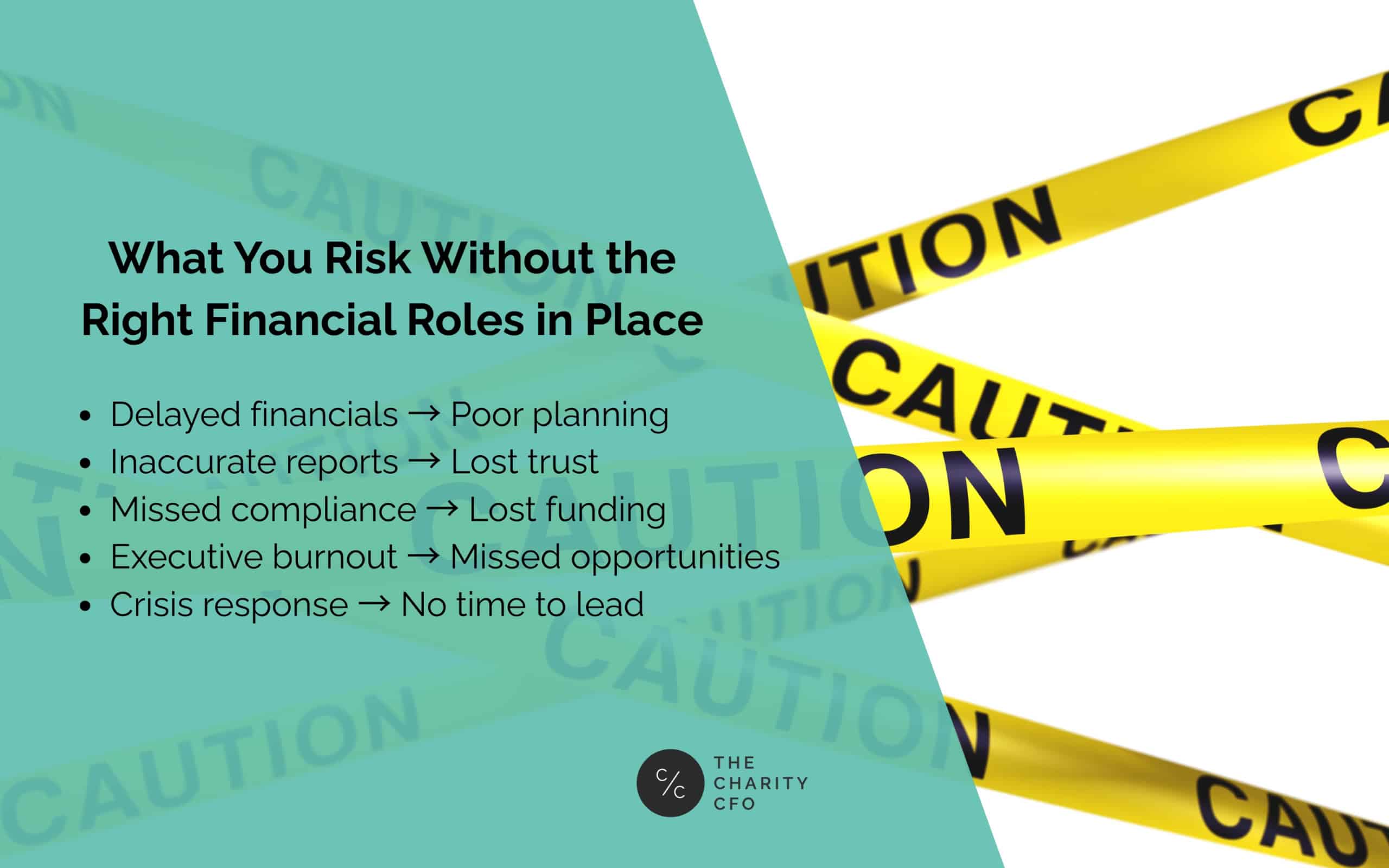
When a nonprofit tries to operate without both roles—bookkeeper and financial leader—the cracks start to show quickly.
Maybe your books fall behind because your finance lead is stuck in the weeds of data entry. Or your reports are unreliable because your bookkeeper doesn’t have the training to interpret them strategically. Maybe your executive director is juggling reconciliations at night and grant reports by day—leaving no time to lead, fundraise, or grow the mission.
You get:
- Delayed financials that make it nearly impossible to budget, plan, or pivot
- Inaccurate reports that confuse your board and erode donor confidence
- Compliance red flags and missed grant deadlines that put funding at risk
- Burned-out leaders doing tasks they were never hired—or trained—to do
And here’s the scariest part:
Most nonprofits don’t realize how broken their accounting is until it becomes a crisis—a missed audit, a cash flow emergency, or a board member demanding answers you don’t have.
When the structure isn’t there, the stress compounds and chaos creeps in.
What Happens With the Right Team?
A skilled accounting team unlocks:
- Accurate, timely financial reporting
- Strategic cash flow planning and forecasting
- Compliance with federal, state, and grant requirements
- Stronger board engagement through clear, transparent reports
- More time for your leadership team to focus on mission and growth
It also builds trust—internally with your team and externally with your funders.
Pro Tip: Outsourcing Can Be a Smart Move
Many small to mid-sized nonprofits don’t need a full-time CFO or in-house accounting department. In fact, outsourcing these roles can give you more expertise at a lower cost, without the overhead or hiring headache.
At The Charity CFO, we specialize in being that full accounting team for growing nonprofits. But whether you work with us or another firm, the principle remains:
You need both day-to-day bookkeeping accuracy and strategic financial leadership.
Bottom Line
If your accounting team is one person in a back office…
Or if it’s just you and a spreadsheet…
Or if you don’t know how up-to-date your books are right now…
It’s time to take this seriously.
You can’t build financial clarity without a skilled accounting team.
And you can’t build sustainability without clarity.
This principle isn’t about perfection. It’s about putting the right people in place to support your mission—so your finances become a springboard, not a stumbling block.
READY TO GO FURTHER?
If you’re ready to turn these best practices into action, our team of fractional CFOs for nonprofits can help. Contact us to start your financial transformation.
📬 Join Our Newsletter
No time to read this article now? Download it for later.
Follow Us Online
Stay connected and get more exclusive content on:
- Website: https://www.thecharitycfo.com
- Instagram: @thecharitycfo
- Facebook: https://www.facebook.com/thecharitycfo
- LinkedIn: https://www.linkedin.com/company/the-charity-cfo-llc
- TikTok: @thecharitycfo
- Spotify: https://open.spotify.com/show/6hofQXPCxiPZuZy3OecW8y
- Apple Podcasts: https://podcasts.apple.com/us/podcast/a-modern-nonprofit-podcast/id1542301310