• NEWSLETTER
    • Schedule a Call
    The Charity CFO
    • Services
      • Bookkeeping
      • Accounting
      • Grant Management
      • Budgeting & Forecasting
      • Audit Assistance
      • System Migration & Tech Integration
      • Tax Preparation
    • Who We Serve
      • Human & Social Services
      • Education & Workforce Development
      • Youth & Community Development
      • Health & Human Services
      • Legal, Advocacy & Civil Rights
      • Religious & Faith-Based
      • Arts, Cultural & Environmental
      • Fundraising & Philanthropy
      • Animal Rights and Welfare
    • About
      • Our Team
      • Our Process
    • Resources
      • Blog
      • Podcast
      • Testimonials
      • Newsletter
    • Careers
    • Menu Menu
    Accrual-Basis Accounting

    Why Nonprofits Need to Switch from Cash-Basis to Accrual-Basis Accounting

    July 12, 2024/in Accounting, Nonprofit/by Paul Cook

    No time to read this article now? Download it for later.

    The type of accounting your organization uses could be holding you back from getting the most out of your accounting system. While many nonprofits start with cash-basis accounting due to its simplicity, this method often falls short of providing a comprehensive view of a nonprofit’s financial health.

    Transitioning to accrual-basis accounting can offer a more accurate representation of finances and enhance long-term planning. Let’s look at the differences between cash-basis and accrual accounting and why you might want to switch.
    Accrual-Basis Accounting

    Understanding Cash-Basis vs. Accrual-Basis Accounting

    Before we can know why to switch accounting systems, it’s important to understand how each system works. The main difference between cash-basis and accrual-basis accounting is when revenue and expenses are recorded.

    In cash-basis accounting, revenue gets reported only when the cash is physically (or digitally) received. Likewise, expenses are recorded when money leaves the organization’s account. Cash-basis accounting is most common for smaller nonprofits, where financials tend to be less complicated.

    Accrual-basis accounting, on the other hand, records revenue and expenses when they are incurred. The accrual-basis method records transactions with the assumption that the money will physically change hands in the future.

    For example, a nonprofit provides a paid service to a community member and issues an invoice. The revenue from the service is recorded now, even though the invoice hasn’t yet been paid.

    Limitations of Cash-Basis Accounting for Nonprofits

    Cash-basis accounting is a simple method that’s great for new or small nonprofits. However, there are two major limitations to using the cash-basis method:

    • It inaccurately represents financial health.
    • It can cause challenges in long-term financial planning.

    The timing of an organization’s income and expenses in cash-basis accounting can misrepresent the actual financial state of the nonprofit. Additionally, the cash-basis method can make accurate forecasting and budgeting difficult.

    Say a nonprofit hosts a large fundraising event in the second quarter. The costs for the event are all paid in the first quarter, but donation funds and other revenue won’t come through until the second quarter.

    By using the cash-basis method, this organization would look like it’s struggling financially in the first quarter but has a major surplus in the second. The reality is somewhere in the middle, but the organization may be tempted to under budget for the first quarter and over budget for the second.

    Benefits of Accrual-Basis Accounting for Nonprofits

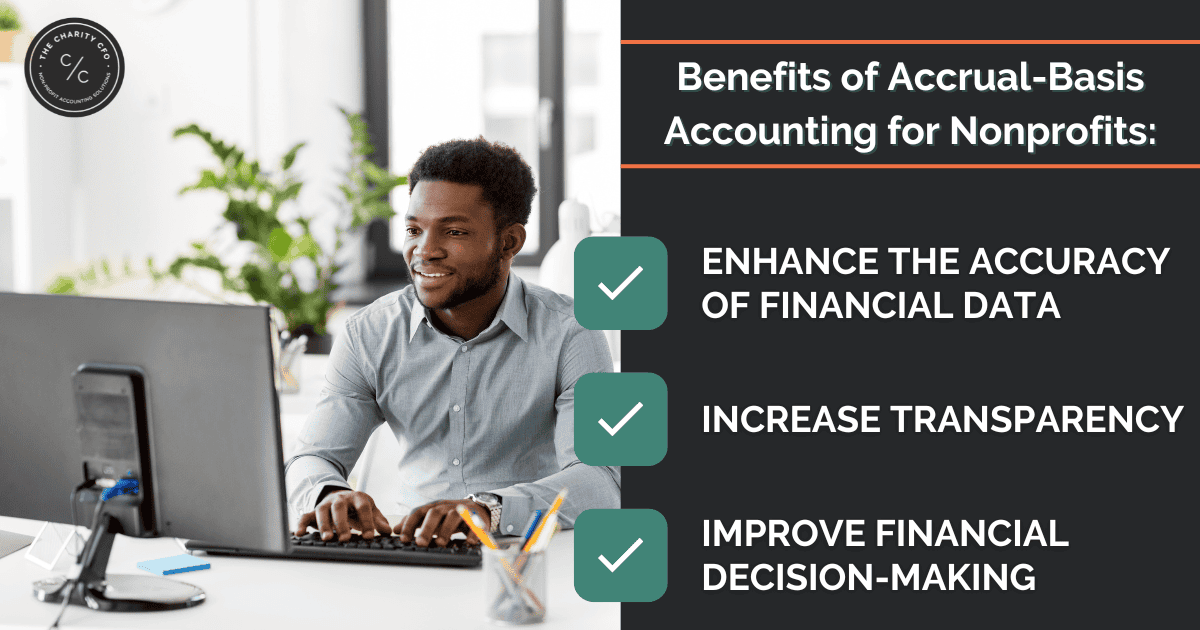
    Switching to accrual-based accounting can have a lot of benefits for nonprofit organizations. Most importantly, making the switch can help your organization:

    • Enhance the accuracy of financial data
    • Increase transparency
    • Improve financial decision-making

    Enhanced Financial Accuracy

    By recording revenue and expenses when they happen, instead of when cash is exchanged, helps provide a more accurate picture of the organization’s financial health at any given time. You’ll get a better view of long-term financial transactions, rather than just seeing what cash is currently in an account.

    Accrual accounting also helps keep related revenues and expenses together. Matching revenues with the expenses incurred to generate them reflects the true cost of running programs and services.

    Improved Financial Transparency

    Accrual accounting provides stakeholders with a detailed view of your organization’s financial activities, improving trust and confidence. Transparent financial reporting can also improve donor relations. With increased transparency through accrual accounting, donors can see how their contributions are being used and the impact they’re making.

    Better transparency also helps you stay compliant with regulations or grant requirements. Many regulatory bodies and grantors require accrual-basis financial statements. Adopting the accrual method ensures compliance with Generally Accepted Accounting Principles (GAAP) and other relevant standards. By making the switch, you could open your organization up to more grants and funding opportunities.

    Facilitates Better Decision-Making

    A more accurate understanding of your organization’s financial health means nonprofit leaders can make better strategic, data-driven decisions. Accrual accounting provides the data needed to forecast cash flow, budget more effectively, and allocate resources where needed most.

    An accrual-based accounting system also gives you insights into the efficiency and effectiveness of programs and services. Detailed financial reports generated using the accrual method can highlight inefficiencies and areas for improvement within your organization. By analyzing the financial performance of programs, you can determine which initiatives are delivering the most value–and which may need adjustments or more support.
    Accrual-Basis Accounting

    Get Support for Your Cash-Basis to Accrual-Basis Transition

    The cash-basis accounting method is simple, but simplicity could be holding your organization back. Moving from cash-basis to accrual-basis accounting can help your nonprofit better manage its financial health and improve transparency. 

    While switching to accrual-basis accounting can be daunting, the easiest way to make the switch is to work with a trusted nonprofit accounting firm, such as The Charity CFO.

    Our dedicated team of accounting professionals specializes in nonprofit accounting–ensuring your organization gets advice from accountants who understand the unique needs of nonprofits. Get in touch today to see how we can help you transition accounting systems!

    No time to read this article now? Download it for later.

    Tags: accounting, nonprofit, nonprofit accounting
    Share this entry
    • Share on Facebook
    • Share on X
    • Share on WhatsApp
    • Share on Pinterest
    • Share on LinkedIn
    • Share on Tumblr
    • Share on Vk
    • Share on Reddit
    • Share by Mail
    You might also like
    What is Financial Oversight? Nonprofit Accounting Tips, Tools, & Tricks Your Organization Needs to Know
    Coronavirus Can Nonprofits Survive Coronavirus?
    5 Reasons to Consider Outsourcing for Nonprofits
    6 Factors to Consider When Hiring an Accounting Service for Nonprofits
    7 Common Fundraising Mistakes to Avoid for Nonprofits
    The Different Types of Audit Services and What They Mean For Your Nonprofit
    The Insider’s Guide to Bookkeeping Services For Nonprofit Organizations
    How to Manage Payroll as a Nonprofit
    Popular
    • What is Financial Oversight?
      Nonprofit Accounting Tips, Tools, & Tricks Your Organization...January 22, 2020 - 4:23 pm
    • nonprofit fundraising strategies
      Do Nonprofits Pay Taxes? This is What You Should KnowJanuary 22, 2020 - 4:31 pm
    • The Charity: 6 Common Tax Mistakes that Non-Profits Mak...January 22, 2020 - 4:55 pm
    • We’re Hiring!January 29, 2020 - 9:31 pm

    Categories

    • 501c3
    • Accounting
    • Accounting, Budgeting & Leadership Strategy
    • Accounting|Audit|CharityCFO
    • Accounting|Audit|Grants|Nonprofit|Reporting|Taxes
    • Accounting|Audits|Expenses|Fundraising|Grants|Nonprofit|Operations|Reporting
    • Accounting|Board Management|Leadership|Nonprofit|Operations
    • Accounting|CharityCFO
    • Accounting|Expenses|Grants|Nonprofit|Reporting
    • Accounting|Fundraising|Grants
    • Accounting|Leadership|Nonprofit
    • Audit
    • Audits
    • Board Management
    • CFO Responsibilities
    • CFO Services Transition
    • CharityCFO
    • CharityCFO|Nonprofit
    • Compliance and Taxation
    • COVID-19 Response
    • Cryptocurrency
    • Diversified Funding Models
    • Expenses
    • Fractional & Outsourced Executive Services
    • Fundraising
    • Grants
    • Investment
    • Leadership
    • Leadership|Nonprofit|Operations
    • Miscellaneous
    • Nonprofit
    • Nonprofit Financial Leadership
    • Nonprofit Financial Maturity
    • Nonprofit Financial Operations
    • Nonprofit Revenue Strategies
    • Nonprofit Revenue Strategy
    • Nonprofit Strategic Leadership
    • Operations
    • Payroll
    • Reporting
    • Taxes
    • Team Contribution
    • Team News
    • Trending
    • Uncategorized
    Left Aligned Cfo Logo White

    Who We Are

    About Us

    Our Team

    Testimonials

    Careers

    Terms and Conditions

    How We Help

    Bookkeeping

    Accounting

    Grant Management

    Budgeting & Forecasting

    Audit Assistance

    System Migration & Tech Integration

    Tax Preparation

    Get in Touch

    1310 Papin Street, Suite 300

    St. Louis, MO 63103

    (314) 390-0220

    [email protected]

    Website by Abstrakt Marketing Group ©
      • Sitemap
      • Privacy Policy
      Link to: Pause and Reflect: Midyear Nonprofit Financial Review Link to: Pause and Reflect: Midyear Nonprofit Financial Review Pause and Reflect: Midyear Nonprofit Financial ReviewNonprofit financial review Link to: The Difference between a Bookkeeper, an Accountant, and a CFO Link to: The Difference between a Bookkeeper, an Accountant, and a CFO AccountantsThe Difference between a Bookkeeper, an Accountant, and a CFO
      Scroll to top Scroll to top Scroll to top

      This site uses cookies. By continuing to browse the site, you are agreeing to our use of cookies.

      AcceptLearn more

      Cookie and Privacy Settings


      How we use cookies

      We may request cookies to be set on your device. We use cookies to let us know when you visit our websites, how you interact with us, to enrich your user experience, and to customize your relationship with our website.

      Click on the different category headings to find out more. You can also change some of your preferences. Note that blocking some types of cookies may impact your experience on our websites and the services we are able to offer.

      Essential Website Cookies

      These cookies are strictly necessary to provide you with services available through our website and to use some of its features.

      Because these cookies are strictly necessary to deliver the website, refusing them will have impact how our site functions. You always can block or delete cookies by changing your browser settings and force blocking all cookies on this website. But this will always prompt you to accept/refuse cookies when revisiting our site.

      We fully respect if you want to refuse cookies but to avoid asking you again and again kindly allow us to store a cookie for that. You are free to opt out any time or opt in for other cookies to get a better experience. If you refuse cookies we will remove all set cookies in our domain.

      We provide you with a list of stored cookies on your computer in our domain so you can check what we stored. Due to security reasons we are not able to show or modify cookies from other domains. You can check these in your browser security settings.

      Other external services

      We also use different external services like Google Webfonts, Google Maps, and external Video providers. Since these providers may collect personal data like your IP address we allow you to block them here. Please be aware that this might heavily reduce the functionality and appearance of our site. Changes will take effect once you reload the page.

      Google Webfont Settings:

      Google Map Settings:

      Google reCaptcha Settings:

      Vimeo and Youtube video embeds:

      Accept settingsHide notification only
      X

      Help Center

      Running a Nonprofit Is Hard. We’re Here to Help.

      Receive expert tips, financial guidance, and real-world advice—straight delivered to your inbox.

      Subscribe
      Discover The Charity CFO Financial Blueprint: Tips from The Best Nonprofit Organizations
      Download Our Playbook